Why decide before you apply
Most job seekers are told to apply widely. So they send the same CV to every role that looks close, tailor a few of them late at night, and hear nothing back. The silence teaches nothing, because a rejection for a poor fit looks exactly like a rejection for a weak CV.
Tailoring a CV for a role you should skip is the most expensive mistake in a job search: you spend an hour polishing a mismatch. Deciding first flips that. You spend a few minutes checking fit, skip the roles that were never realistic, and put your effort into the ones where your real experience matches.
The six-question fit check
Read the job ad once with these questions in mind. You can answer most of them in five minutes.
- Do you meet the must-haves? A required degree, licence, work permit or minimum years of experience are hard filters. If one is missing, the application usually stops there.
- Is the seniority within one step of yours? A fresher applying for a senior role, or a team lead applying for a junior one, is filtered quickly in both directions.
- Can you show the top three duties with real examples? The first duties listed are what the hiring manager will check you against. If you have done each of them, even under a different name, you are a real candidate.
- How many of the tools and skills are already on your CV? Count them. If most are there, the job fits; if most are missing, the gap is real.
- Is each gap a wording gap or a real gap? A wording gap is something you did but did not write down. A real gap is something you have not done. Wording gaps take ten minutes to fix; real gaps do not.
- Would you actually take it? Pay, location, hours and the kind of work matter. An offer you would turn down is not worth an evening.
Must-haves versus nice-to-haves
Job ads mix two kinds of requirements. Must-haves sit under headings like “What you’ll need” or “Requirements” and describe the work you will do every week. Nice-to-haves sit under “Bonus” or “Nice to have” and are often a wish list for the ideal candidate who rarely exists.
Skip a job when you miss a must-have that you cannot honestly cover. Do not skip a job because you miss a nice-to-have: most people who get hired do not tick every box. If you meet the must-haves and can show the main duties, apply.
A worked example
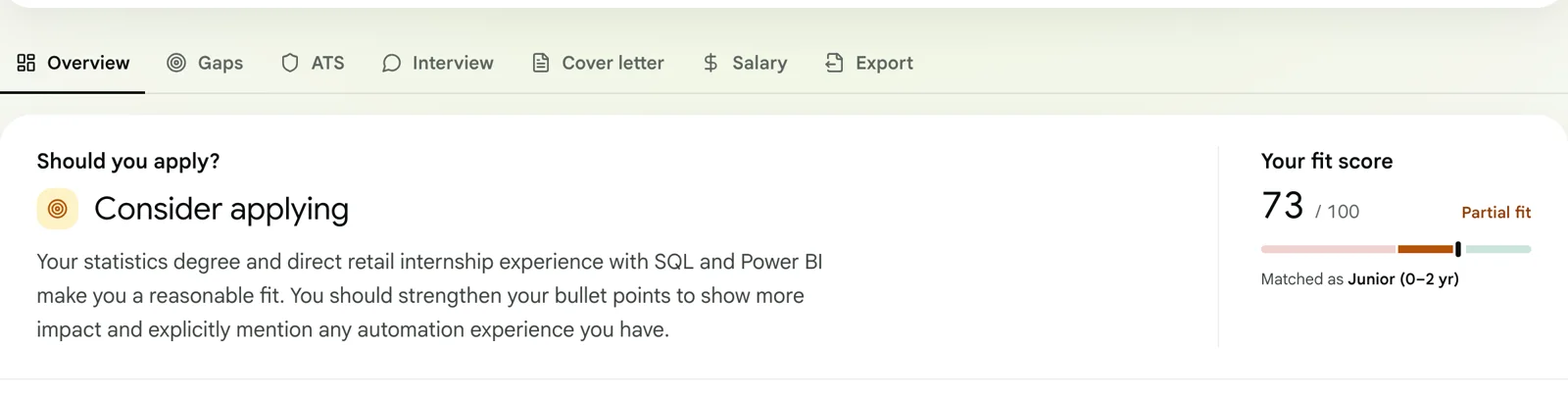
Here is a real fit check from Litgo for an example candidate: a statistics graduate with a six-month retail analytics internship, applying for a Junior Data Analyst role. The person and the job are made up for this demo; the scores are Litgo’s real output.
The verdict was “Consider applying” with a fit score of 73 out of 100. Technical skills and education matched every requirement. Experience met four of eight requirements, partly met one and did not show three. Leadership scored lowest, which is normal for a first job.
Read the gaps, not just the score
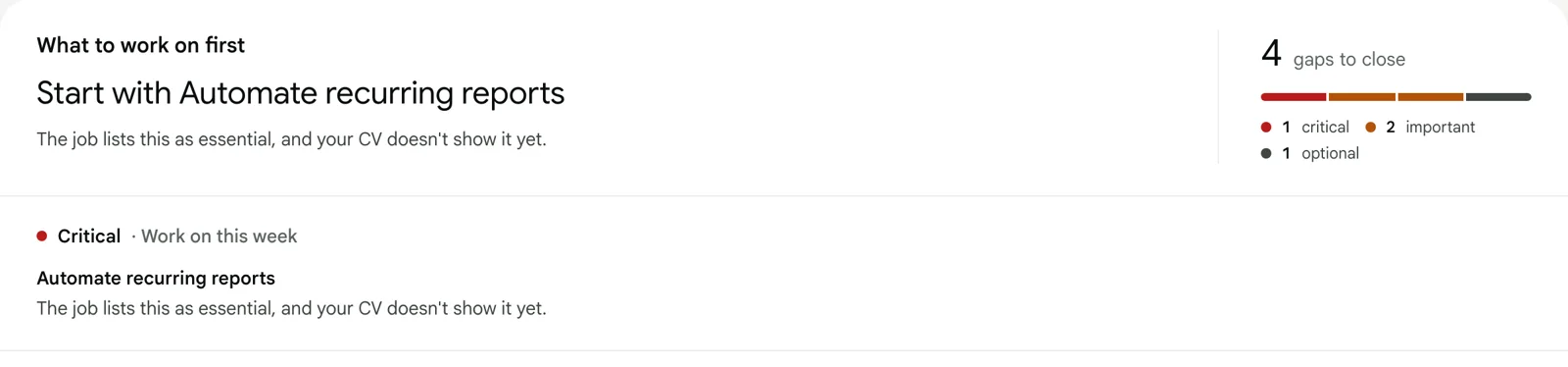
The gaps matter more than the number. Litgo listed four: one critical, two important and one optional. The critical one was “automate recurring reports”, which the job listed as essential and the CV did not show.
That turned out to be a wording gap. The candidate had automated a weekly sales report with a scheduled Python script during the internship, but had never written it down. Once she added that one true line, her fit score went from 73 to 82. Nothing was invented; the CV simply started to show what she had done.
Apply, tailor or skip: what to do with the answer
Turn the answer into one of three actions:
- Strong fit: tailor your CV to the job and apply this week, while the role is fresh.
- Partial fit: fix the wording gaps first, using only things you have really done, then decide. Many “Consider applying” jobs become strong applications after ten minutes of honest editing.
- Poor fit: skip it without guilt, and note the missing skill. If the same gap shows up in several jobs you want, that is the thing to learn next.
Common mistakes
- Keyword stuffing: pasting the job’s words into your CV without the experience behind them. It may pass a keyword filter, but the person reading it will notice.
- Rewriting before reading: editing your CV before you have checked whether the job fits at all.
- Closing gaps with fiction: adding a tool, a number or a responsibility you did not have. It reads well until the interview asks about it.
- Counting applications instead of matches: ten well-matched applications usually do more than a hundred generic ones.
Do the check in about a minute
You can run this check by hand with the questions above. If you want it done for you, paste your CV and the job ad into Litgo’s free fit check. You get the verdict, the fit score, what is working, the gaps by priority and how an applicant tracking system reads your file, with no sign-up.
For how the verdict is worked out, read how Litgo decides Strong Apply versus Skip. When a job is worth it, the next step is to tailor your CV to the job description.
Frequently asked questions
Should I apply if I don’t meet all the requirements?
Usually yes, if you meet the must-haves and can show the main duties with real examples. Nice-to-haves are a wish list; most people who get hired do not tick every box. Skip only when you miss a hard requirement such as a required licence, degree or work permit.
How many jobs should I apply to each week?
There is no magic number. A handful of well-matched, tailored applications usually does more than dozens of generic ones. Spend your time on the roles that pass the fit check.
Is a job fit score the same as an ATS score?
No. A fit score measures whether your experience matches the job. An ATS check measures whether software can read your CV file correctly: your name, dates and jobs. You need both; Litgo has a free ATS checker as well as the fit check.
Does a low fit score mean I won’t get the job?
No. It is a signal about how well your CV matches the ad, not a prediction. A referral, a portfolio or a strong cover letter can still win a role (Litgo’s free cover letter generator writes one from your CV and the job ad). Use the score to decide where to spend your time, and to find wording gaps you can fix honestly.