ChatGPT is good at words, not at your facts
ChatGPT and similar assistants write fluent, confident text. That makes them useful for rewording a CV, and risky for tailoring one. When you ask “tailor my CV to this job”, the model sees the gap between your CV and the job ad, and the most helpful-sounding answer is to close it: a tool you never used, a number you never measured, a team you never led.
The fix is not to stop using AI. It is to give it rules about facts, check what it returns, and know which parts of an application it cannot do for you.
Five ways AI rewrites go wrong
- Invented numbers: “increased efficiency by 37%” when nobody measured anything.
- Tools you never used: the job asks for Tableau, so Tableau appears in your skills.
- Inflated scope: a three-month internship that “led company-wide strategy”.
- Changed facts: job titles upgraded, dates stretched, a degree reworded into something it is not.
- Buzzword fog: spearheaded, leveraged and synergised on every line, until nothing specific is left.
Prompts that keep ChatGPT honest
Paste your CV and the job ad, then use prompts like these. Copy them as they are or adapt them.
- “Tailor my CV to this job. Do not add any skill, tool, number, employer, job title, date or qualification that is not already in my CV. You may reword and reorder my existing bullets.”
- “After the CV, list every requirement in the job ad that my CV does not show. Do not write anything about them.”
- “For each bullet you changed, quote the original line from my CV that it comes from.”
- “Before writing anything about [requirement], ask me what I actually did. If I say I have not done it, leave it out.”
- “Rewrite this bullet in under 20 words, keep every fact the same and use the job’s wording where it fits: [bullet].”
Check the output yourself
Even with good prompts, read the result against your original CV before you send it:
- Compare it line by line with your original. Anything that is not in the original needs a reason to be there.
- Remove every number you could not explain in an interview.
- Remove every tool you could not talk about for two minutes.
- Keep job titles, employers and dates exactly as they are.
- Read it aloud. If a line sounds like nobody in particular, rewrite it with a real example.
Where ChatGPT still falls short
Prompts reduce invented facts, but a general chatbot was not built for job applications, and some parts of the job it simply does not do:
- It does not tell you whether the job is worth applying for. It will tailor your CV to any ad you paste in.
- It cannot see how an applicant tracking system reads your file: columns, tables and headings that scramble your name and dates.
- It does not keep your career history between applications unless you paste it in every time, and it will not track which version went to which job.
- Its cover letters drift toward stock phrases. In Litgo’s free cover letter checker, a generic “hard-working team player” letter scored 11 out of 100 for specificity; a letter written from the person’s real CV with the cover letter generator scored 88.
What Litgo does instead
Litgo is built around one rule: nothing is invented. It checks the job fit before any rewriting. When it tailors your CV, every rewritten line is checked against your original, and anything that is not in it is removed. If the job asks for something your CV does not show, Litgo asks whether you have done it instead of adding it.
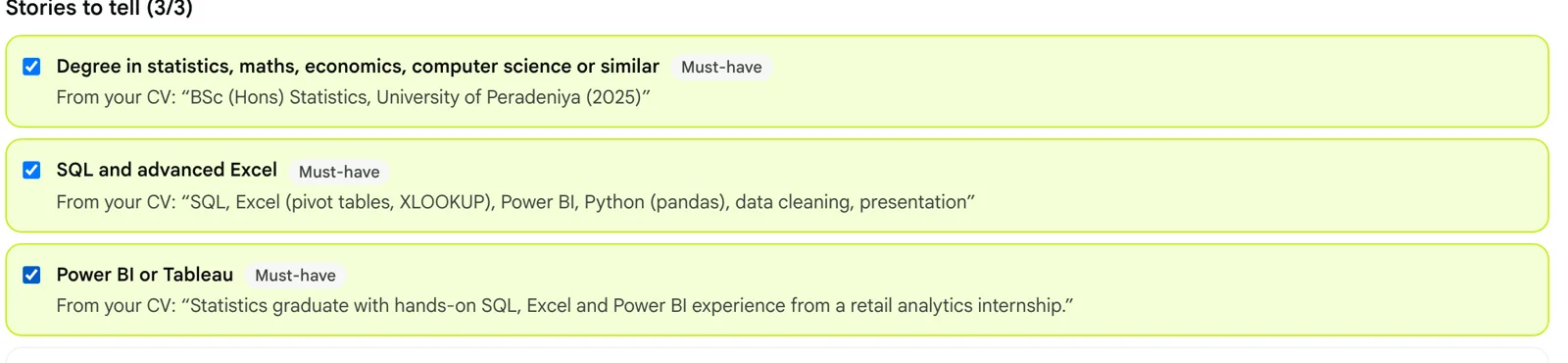
In a real example, the fit score stayed at 73 after tailoring because Litgo would not add skills the CV did not show. It rose to 82 only after the candidate confirmed one thing she had really done. The cover letter works the same way: each story it tells quotes the line in the CV it comes from.
When to use which
Use ChatGPT to brainstorm wording, shorten a bullet you already wrote, or practise interview answers once your facts are fixed. Use Litgo when you need to know whether a job is worth applying for, and want a tailored CV, cover letter and interview prep for that job that you can defend line by line.
For a side-by-side table, read Litgo vs ChatGPT for resumes. To see how the fact check works, read how a fact-preserving rewrite works. If you build AI assistants, see Litgo for AI assistants.
Frequently asked questions
Is it OK to use ChatGPT to write my CV?
Yes, for wording, as long as every fact is yours. Recruiters care whether your CV is true and specific, not which tool helped you phrase it. Use prompts that forbid new facts, and check the result against your original.
Can recruiters tell if ChatGPT wrote my CV?
Many notice the signs: the same buzzwords on every line, numbers with no context and skills the rest of the CV does not support. The bigger risk is the interview, where any claim you cannot explain is exposed.
Will an ATS reject a CV written with ChatGPT?
An applicant tracking system reads your file; it does not judge who wrote it. What causes problems is layout: columns, tables and text in images. Check what an ATS reads from your file with the free ATS checker.
Does Litgo use ChatGPT?
No. Litgo uses Google’s Gemini and Anthropic’s Claude, under rules about what they may and may not add, and every rewritten line is checked against your original CV before you see it.